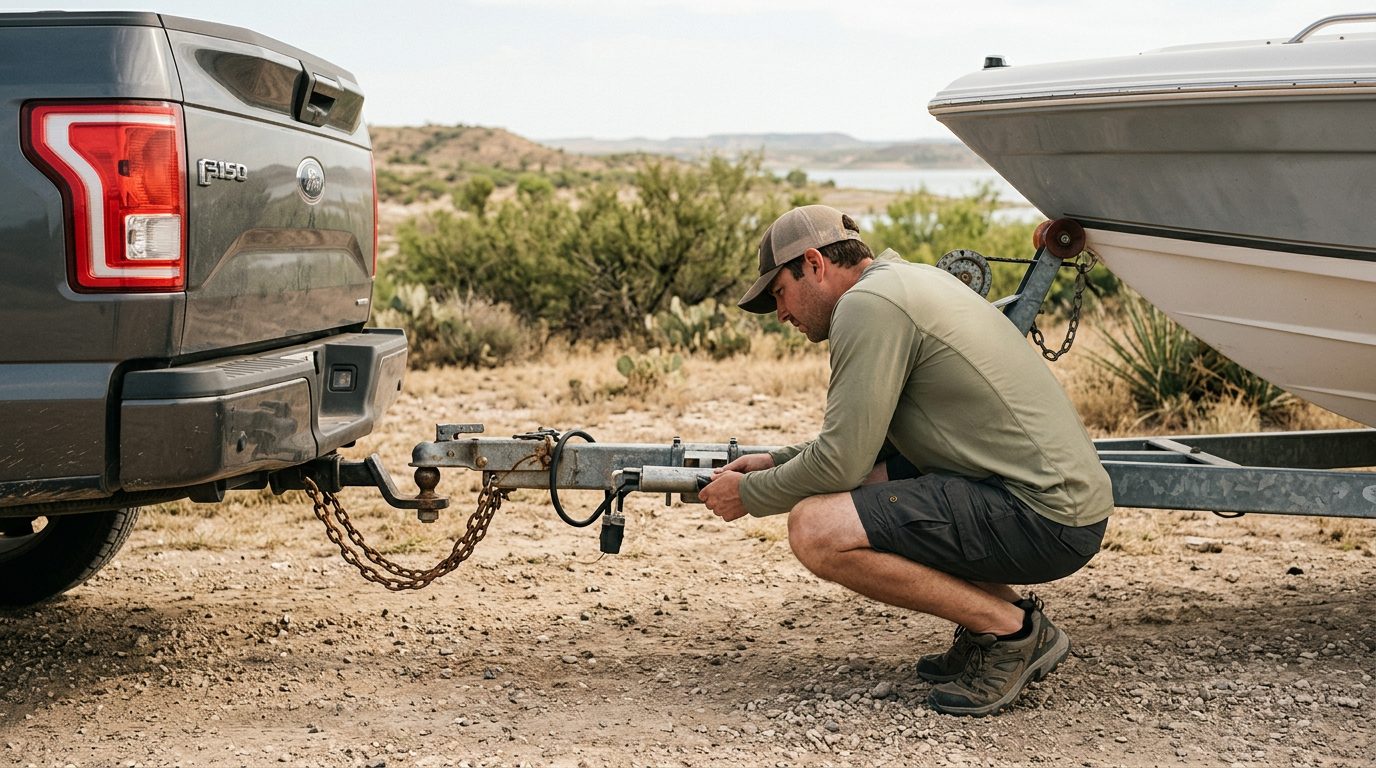
Why Is a Supplemental Transmission Cooler Recommended for Towing to Lake Amistad? A supplemental transmission cooler lowers fluid operating temperatures by up to 50 degrees Fahrenheit, preventing fluid oxidation and thermal breakdown while pulling heavy boat trailers in high summer heat. When hauling heavy loads up steep launch ramps around Lake Amistad, an auxiliary cooler protects internal clutches and valves from catastrophic thermal failure. As a Service Director with over a decade of hands-on experience in fixed operations, I see what heavy trailering does to stock automatic transmissions during South Texas summers. Automatic transmission fluid breaks down rapidly when temperatures exceed 220 degrees. Pulling a 5,000-lb pontoon or fiberglass bass boat against headwinds pushes factory fluid past its normal thermal limits. Installing a dedicated heat exchanger ensures your EcoBoost® engine and automatic transmission maintain safe operating hydraulic pressure under sustained load. Before hitching up for your next trip, check that your transmission fluid is clear red and free of a burnt odor. If you want our service team to test your cooling system pressure or inspect fluid condition, give us a quick call or stop by our Del Rio service center location on Veterans Blvd. Table of Contents What Towing Capacity Is Required to Safely Haul a Boat to Lake Amistad? What Are Texas Legal Trailer Brake Requirements When Towing a Boat? Surge Brakes vs. Electric-Over-Hydraulic Brakes: Which Is Best for Boat Trailers? Can You Tow a Heavy Boat Without a Factory Tow Package? Why Schedule a Professional Pre-Towing Inspection Before Your Boat Trip? What Towing Capacity Is Required to Safely Haul a Boat to Lake Amistad? Safely towing a boat requires a vehicle rated for at least 10% to 20% above the combined gross weight of the boat, trailer, fuel, and onboard equipment. Most medium-sized pontoon and fiberglass bass boats weigh between 3,500 lbs and 6,000 lbs fully loaded, requiring a tow vehicle with a minimum towing capacity of 6,000 lbs to 7,500 lbs to maintain steering control and braking stability. Calculating total weight requires accounting for more than dry hull figures on a spec sheet. Gasoline weighs roughly 6.1 lbs per gallon, and adding full fuel tanks, trolling batteries, fresh water, anchors, fishing gear, and coolers easily adds 500 lbs to 1,000 lbs beyond the base trailer weight. Tongue weight is another critical factor; your setup must maintain between 7% and 15% of the total loaded trailer weight on the hitch ball. Too little tongue weight triggers dangerous trailer sway at highway speeds, while excessive tongue weight overloads the rear axle and reduces front steering traction. The highway trip across Uvalde features rolling terrain that demands consistent engine torque and proper load distribution across every axle. Vehicles like the Ford F-150 offer up to 13,500 lbs of maximum towing capacity when properly equipped, providing plenty of reserve power and thermal safety margin for long lake trips. What Are Texas Legal Trailer Brake Requirements When Towing a Boat? Texas state law mandates independent braking systems on any trailer with a gross weight exceeding 4,500 lbs. Additionally, the trailer brake system must feature an automatic breakaway mechanism capable of applying the brakes and bringing the trailer to a complete stop if it detaches from the tow vehicle. Maintaining legal and functional trailer brakes is critical when hauling heavy watercraft on public roads. Under Texas regulations, passenger cars and light trucks towing trailers must also use two properly rated safety chains crossed beneath the trailer tongue. Crossing the chains creates a cradle that catches the coupler if it accidentally unlatches from the hitch ball. Before departing, visually inspect trailer brake shoes, drums, hydraulic lines, and electrical connections to ensure full operation. You can easily schedule a service appointment online to have our technicians inspect your brake linings, check hub seals, and test your trailer brake controller before heading out. Surge Brakes vs. Electric-Over-Hydraulic Brakes: Which Is Best for Boat Trailers? Electric-over-hydraulic (EOH) brakes provide superior stopping power, faster response times, and cab-controlled adjustment for heavy boat trailers, whereas mechanical surge brakes offer reliable, self-contained stopping power that requires no in-cab controller and withstands repeated water submersion during ramp launches. Surge brakes operate mechanically using the trailer's forward momentum against the hitch ball. When the tow vehicle slows, kinetic force compresses a hydraulic master cylinder inside the trailer tongue, pressurizing the brake lines to slow the trailer wheels. This self-contained design makes surge systems popular on light-to-medium boat trailers because there are no electric magnets inside the brake drums to short out when backing into water. However, surge brakes cannot be manually activated from the driver's seat and can delay response times on downhill grades. EOH systems pair an electric brake controller inside the vehicle cab with an onboard electric hydraulic pump mounted on the trailer frame. Pressing the vehicle brake pedal instantly signals the hydraulic pump to actuate heavy-duty disc brakes. EOH systems provide proportional stopping power and allow drivers to manually trigger trailer braking to control sway. For boat setups over 5,000 lbs, EOH brakes combined with an integrated Ford trailer brake controller deliver maximum safety and control. Can You Tow a Heavy Boat Without a Factory Tow Package? Towing a heavy boat without a factory tow package is possible only if you install properly rated aftermarket upgrades, including a Class III or Class IV hitch receiver, auxiliary transmission cooling, a multi-pin electrical harness, and a trailer brake controller. Factory tow packages bundle essential hardware engineered to handle heavy tongue weights and engine heat under continuous strain. Beyond a frame-mounted receiver hitch, factory-equipped trucks include upgraded engine cooling fans, heavy-duty radiators, transmission fluid heat exchangers, vehicle wiring harnesses, and recalibrated shift software. Attempting to pull a 5,000-lb boat on a standard bumper or light-duty vehicle without these cooling and electrical upgrades risks severe transmission overheating and brake fatigue. If your vehicle lacked a factory package from the line, installing an auxiliary transmission cooler and a heavy-duty wiring harness helps close the performance gap. Utilizing built-in tow features like Ford Tow/Haul mode changes transmission shift timing to hold lower gears longer on climbs and provide engine braking during steep descents, reducing heat buildup in your vehicle's service brakes. Why Schedule a Professional Pre-Towing Inspection Before Your Boat Trip? A professional pre-towing inspection identifies hidden safety hazards such as dry-rotted tire sidewalls, contaminated wheel bearing grease, oxidized brake fluid, and weak electrical grounds before they cause highway breakdowns or ramp failures. Boat trailers undergo severe wear cycles compared to standard utility trailers. Repeatedly backing hot wheel hubs into cold lake water creates a vacuum inside the hub cavity, drawing water past rubber grease seals. Over time, water contamination breaks down bearing grease, leading to bearing overheating, axle scoring, and catastrophic wheel detachment on the highway. Professional technicians remove hub dust caps, inspect grease condition, pack bearings with marine-grade grease, check tire pressure on all tires including the spare, and verify electrical continuity across all tail lights and brake circuits. Our technicians examine tow vehicle hitches, cooling systems, brake linings, and electrical connections to keep your trip safe and worry-free. If you want complete peace of mind before your next outing, give our team a quick call or get directions to our service department to schedule a comprehensive pre-towing check. © 2026 Cecil Atkission Ford Del Rio. All rights reserved.