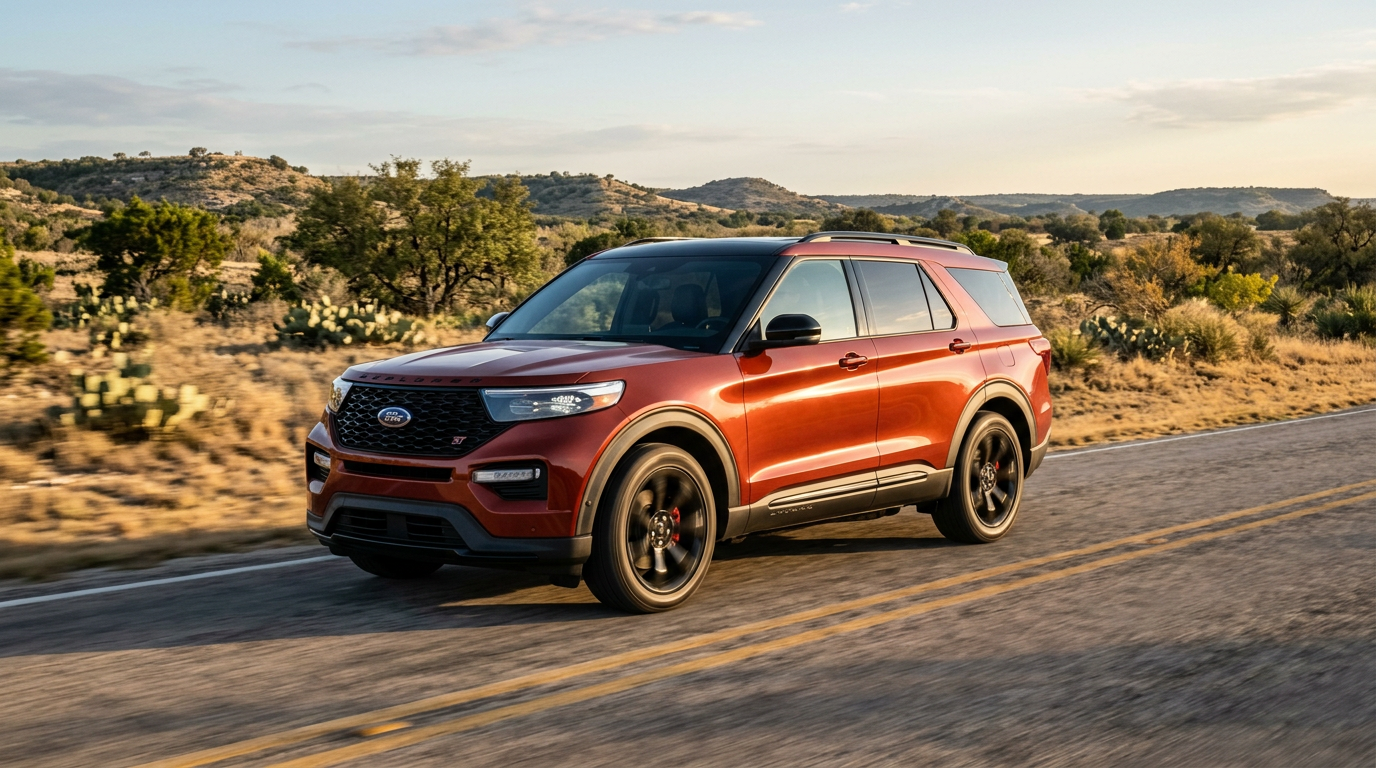
The 2027 Ford Explorer is the right pick for Del Rio families who need three-row space, genuine towing muscle, and everyday practicality in one vehicle. All four covered trims — ST-LINE RWD, ST-LINE 4WD, ST 4WD, and ST — share a 5,000 lb towing rating and 6-passenger seating. The ST-Line trims start at $44,200 and deliver 23 combined MPG, while the twin-turbocharged ST trims start at $53,660 and produce 400 hp for drivers who want more pull on South Texas roads.
Table of Contents
- How Much Does the 2027 Ford Explorer Cost to Own?
- What Makes the 2027 Ford Explorer's Exterior Design Ideal for Del Rio Adventures?
- How Does the 2027 Ford Explorer's Powertrain Perform on Texas Hill Country Roads?
- Which Interior Features of the 2027 Ford Explorer Enhance Comfort for Families?
- What Technology in the 2027 Ford Explorer Simplifies Daily Driving?
- How Do Safety and Driver Assistance Features Protect 2027 Ford Explorer Drivers?
- What Are the MSRP Prices for Each 2027 Ford Explorer Trim?
- What Warranty and Maintenance Plans Support 2027 Ford Explorer Owners?
- Which Awards and Expert Reviews Highlight the 2027 Ford Explorer's Strengths?
- What Are the Top Buyer Questions About the 2027 Ford Explorer?
How Much Does the 2027 Ford Explorer Cost to Own?
The 2027 Ford Explorer lineup covered here spans from $44,200 for the ST-LINE RWD to $55,660 for the ST 4WD, giving Del Rio shoppers a meaningful range of entry points before the $1,795 destination charge is added. The two-engine structure is the clearest budget dividing line: ST-Line trims run the turbocharged 2.3L four-cylinder and deliver noticeably better fuel economy, while the ST trims step up to the twin-turbocharged 3.0L V6 and trade some efficiency for considerably more power.
| Feature | ST | ST 4WD | ST-LINE 4WD | ST-LINE RWD |
|---|---|---|---|---|
| Base MSRP | $53,660 | $55,660 | $46,200 | $44,200 |
All trims share: Destination charge: $1,795
Fuel economy is where the ST-Line trims earn their keep for families making daily runs between Del Rio and Uvalde or heading out to Amistad Reservoir on weekends. The rear-wheel-drive ST-Line stretches to 28 mpg highway, making it the most fuel-efficient option in this group.
| Feature | ST | ST 4WD | ST-LINE 4WD | ST-LINE RWD |
|---|---|---|---|---|
| MPG | 17 city / 25 hwy / 20 combined | 17 city / 24 hwy / 20 combined | 20 city / 27 hwy / 23 combined | 20 city / 28 hwy / 23 combined |
For families watching the fuel budget, that 3 mpg combined difference between the ST-Line and ST trims adds up quickly over a year of daily commutes and weekend reservoir runs. If you want to see what is currently available on the lot, browse our new Explorer inventory or check out pre-owned vehicles in Del Rio for additional options at a range of price points.
What Makes the 2027 Ford Explorer's Exterior Design Ideal for Del Rio Adventures?
The 2027 Explorer cuts a confident silhouette — 198.7 inches long and 78.9 inches wide — that carries real presence on Del Rio's Veterans Boulevard and looks equally at home on the gravel roads leading to Amistad Reservoir. The design is grounded rather than flashy, with a stance built around a 119.1-inch wheelbase that gives the SUV a planted, capable look from any angle.
All four trims wear LED projector-beam headlights with LED daytime running lights, painted front and rear bumpers, and black roof rails as standard. The ST and ST 4WD trims push the visual identity further with painted brake calipers, sport-tuned suspension, and a roof spoiler that gives the hatch a more purposeful look. The ST-Line trims carry their own distinct character — the available ST-Line Street Pack adds 21-inch alloy wheels that fill the arches well and sharpen the overall stance compared to the standard 20-inch rollers.
Color choices reflect the range of personalities in this lineup. Shoppers can select from Avalanche Gray Metallic, Carbonized Gray Metallic, Marsh Gray, Agate Black Metallic, Vapor Blue Metallic, Star White Metallic Tri-Coat, and Ruby Red Metallic Tinted Clearcoat. An optional Black Painted Roof is available across trims for buyers who want a two-tone look that stands out at the border crossing or along the Rio Grande.
Ground clearance sits at 7.6 inches on the ST-Line trims and 7.8 inches on the ST trims — enough to handle the caliche roads and rocky terrain around the reservoir without drama. If you are trading in your current vehicle before stepping into an Explorer, you can get a quick trade-in estimate online to know exactly where you stand before you visit.
How Does the 2027 Ford Explorer's Powertrain Perform on Texas Hill Country Roads?
Two engines, two personalities — and both are built for the kind of driving Del Rio families actually do. The ST-LINE RWD and ST-LINE 4WD run Ford's turbocharged EcoBoost I-4 2.3L four-cylinder, producing 300 hp and 310 lb-ft of torque. The ST and ST 4WD step up to Ford's twin-turbocharged EcoBoost V6 3.0L six-cylinder, rated at 400 hp and 415 lb-ft of torque — a meaningful jump that translates to noticeably stronger passing power on the rolling hills between Del Rio and Uvalde.
| Feature | ST | ST 4WD | ST-LINE 4WD | ST-LINE RWD |
|---|---|---|---|---|
| Engine | 3L | 3L | 2.3L | 2.3L |
| Horsepower | 400 hp | 400 hp | 300 hp | 300 hp |
| Torque | 415 lb-ft | 415 lb-ft | 310 lb-ft | 310 lb-ft |
| Drivetrain | Rear-wheel drive | Four-wheel drive | Four-wheel drive | Rear-wheel drive |
All trims share: Transmission: SelectShift®
Every trim pairs its engine to Ford's SelectShift 10-speed automatic transmission, which keeps the engine in its power band whether you are merging onto US-90 or climbing a grade loaded with camping gear. The ST and ST-LINE trims with rear-wheel drive deliver a more engaging, sport-biased feel on paved roads, while the 4WD variants — both the ST 4WD and ST-LINE 4WD — use Ford's Intelligent 4WD system with terrain selection for added confidence on unpaved surfaces.
Autoblog notes that the 2027 Explorer offers a commendable blend of strong performance, neat handling, and everyday comfort, and that description holds up across all four trims covered here. The ST's 415 lb-ft of torque is particularly useful when the family is loaded up with fishing gear and the boat trailer is hitched. Edmunds goes further, pointing out that the Explorer out-steers, out-handles, and out-accelerates the rest of the three-row pack when you want athleticism — a claim the 3.0L ST trims make easy to believe.
Suspension on the ST and ST 4WD is sport-tuned, pairing front struts and a rear multi-link setup with stiffer calibration for flatter cornering. The ST-Line trims share the same suspension architecture in a comfort-leaning tune. If you are ready to talk numbers, our finance center can help you work through payment options that fit your budget.
Which Interior Features of the 2027 Ford Explorer Enhance Comfort for Families?
Six passengers ride in genuine comfort across all four trims — a 2+2+2 captain's chair configuration is standard, with a three-passenger second-row bench available as an option that bumps total capacity to seven. For the Garcia family heading to Amistad Reservoir with grandparents in tow, that flexibility matters.
The ST and ST 4WD trims come equipped with sport-style front seats featuring five-way power adjustment for the driver, memory settings for the driver's position, electric lumbar for both front occupants, and heated front and rear seats as standard. Seat surfaces on these trims are synthetic suede — a material that looks sharp and handles the South Texas heat better than leather in direct sunlight. The optional Miko Suede with Micro-Perforated Seating Surfaces adds breathability for long summer drives.
ST-Line trims start with upgraded cloth seating, with the optional Onyx Unique Cloth Inserts and Red Stitching available for buyers who want a sportier look inside. The ST-Line Premium Package adds memory driver's seat settings, heated rear seats, and auto-dimming mirrors — bringing the comfort level much closer to the ST trims at a lower price point.
Headroom is generous at 40.7 inches up front, 40.5 inches in the second row, and 38.9 inches in the third row — enough for adults to sit upright without craning. Leg room runs 43 inches in the first row, 39 inches in the second, and 32.2 inches in the third. Shoulder room is 62.1 inches up front and 61.9 in the second row, which means three adults across the middle seat do not feel squeezed.
Cargo behind the third row measures about 16 cu ft — enough for a cooler, fishing rods, and a weekend bag. Fold everything flat and that expands to about 85 cu ft, which handles a full load of camping gear without breaking a sweat. Climate control is a three-zone automatic system on all trims, with rear controls so second-row passengers can manage their own comfort independently.
What Technology in the 2027 Ford Explorer Simplifies Daily Driving?
A 13.2-inch center touchscreen and a 12.3-inch digital instrument cluster are standard across all four trims — the same screen size regardless of whether you choose the entry-level ST-LINE RWD or the range-topping ST 4WD. That consistency is worth noting because it means the technology experience does not feel stripped down just because you stayed within budget.
Wireless Apple CarPlay and wireless Android Auto come standard, so there is no cable to fish out of a bag when you get in the truck after a day at the reservoir. The system includes a built-in Google voice assistant, Bluetooth connectivity, and an embedded Wi-Fi hotspot that runs on an embedded SIM card — 12 months of connectivity is included at purchase, with the option to add the Ford Connectivity Package (a one-time purchase) for seven years of extended service.
Charging is handled across the cabin with four USB ports up front, two in the second row, and two in the third row — eight total. A wireless charging pad is standard on the ST and ST 4WD trims, eliminating the cable clutter that builds up on long drives. The ST-Line Premium Package adds the wireless pad to those trims as well. A 12V outlet is available in the front, rear, and cargo areas, and the ST trims include a 120V household-style power outlet for charging larger devices.
Navigation uses the 13.2-inch screen with satellite view, internet-connected traffic data, and 12 months of map updates included. The 911 Assist telematics system connects automatically in an emergency, and over-the-air software updates keep the system current without a dealer visit. For buyers who want hands-free highway driving, BlueCruise is available as an optional add-on on all four trims — it uses Level 2 partial automation with active lane control and driver monitoring for qualifying divided highways.
Optional SiriusXM with 360L (three-year plan) is available on all trims for buyers who want satellite radio on long stretches of open highway between Del Rio and San Antonio. The ST and ST 4WD trims include a standard 14-speaker Bang & Olufsen audio system with a subwoofer — the ST-Line trims come with a 10-speaker Bang & Olufsen setup that still sounds far better than what you find in most family SUVs.
How Do Safety and Driver Assistance Features Protect 2027 Ford Explorer Drivers?
Every 2027 Explorer in this group — ST-LINE RWD, ST-LINE 4WD, ST 4WD, and ST — carries the same comprehensive safety foundation. There are no stripped-down safety tiers here; Ford equips all four trims with the same core protection package.
The airbag count is seven: dual front airbags, front side airbags, and side curtain airbags covering all three rows, plus a driver's knee airbag. Every seating position across all three rows has its own seat belt with pre-tensioners in the front, and height-adjustable belts for the driver and passenger. LATCH anchor points are included for child safety seats.
Ford CoPilot360 Assist 2.0 is the active safety suite that runs across all trims. It includes automatic emergency braking that activates at speeds as low as 3 mph, a Lane-Keeping System that applies steering correction when the vehicle drifts, BLIS (Blind Spot Information System) with cross-traffic alert, and Rear Cross Traffic Braking — a radar-based system that actually applies the brakes (not just sounds an alert) when it detects cross traffic while you are reversing out of a parking space. That last feature is particularly useful in busy parking lots at local shopping centers or the Walmart on Veterans Boulevard.
The 360-Degree Camera with Split View is standard on all four trims, giving drivers a bird's-eye perspective when maneuvering in tight spaces. Parking sensors front, rear, and side round out the low-speed awareness package. AdvanceTrac with RSC (Roll Stability Control) monitors lateral forces and intervenes when the system detects a rollover risk — meaningful on the sloped terrain around Del Rio's hills.
Crash test ratings from NHTSA show a 5-star overall score, 5 stars in frontal and side impact, and a 4-star rollover rating. IIHS results show a Superior rating in front crash prevention for vehicle-to-pedestrian daytime scenarios and a Good rating in side impact.
What Are the MSRP Prices for Each 2027 Ford Explorer Trim?
The four trims covered here split cleanly into two tiers based on engine and content level, making the buying decision more straightforward than it might first appear.
The ST-LINE RWD at $44,200 is the value entry point — rear-wheel drive, the 2.3L EcoBoost I-4, and the best fuel economy in the group at 23 combined MPG. It is the right choice for families whose driving stays mostly on paved roads and who want to stretch their budget further on options or contact us for current payment information.
Step up to the ST-LINE 4WD at $46,200 and you add Ford's Intelligent 4WD system for $2,000 more. The four-wheel-drive system uses automatic engagement, so there is no lever or button to manage — it responds to conditions on its own. Fuel economy drops slightly to 23 combined MPG (27 highway vs. 28 for the RWD), but the added traction confidence on wet roads or unpaved ranch paths is worth it for many buyers.
The ST at $53,660 represents a $7,460 step up from the ST-LINE 4WD, but it brings the twin-turbocharged 3.0L V6 with 400 hp and 415 lb-ft of torque, sport seats with memory and ventilation, a 14-speaker Bang & Olufsen audio system, wireless charging, and a sport-tuned suspension. For buyers who tow regularly or simply want the most capable version of the Explorer, this trim delivers it in rear-wheel-drive form.
The ST 4WD at $55,660 is the top of this group — same 3.0L V6 powertrain, same feature set as the ST, but with Intelligent 4WD added. All four trims carry the same $1,795 destination charge, and all share the 5,000 lb towing rating and about 16 cu ft of cargo space behind the third row.
The Sun and Sound Package is available on both ST trims and adds a panoramic glass roof with electric operation, a one-touch sunroof, front seat massage function, and the full 14-speaker Bang & Olufsen system upgrade with 980 watts of power. The ST-Line Street Pack adds 21-inch alloy wheels and painted calipers to the ST-Line trims. The ST-Line Premium Package adds ambient lighting, a wireless charging pad, memory driver's seat, heated rear seats, auto-dimming mirrors, and rain-sensing wipers to either ST-Line trim.
What Warranty and Maintenance Plans Support 2027 Ford Explorer Owners?
Ford backs the 2027 Explorer with a straightforward warranty structure that gives Del Rio families solid long-term coverage. The bumper-to-bumper warranty runs 3 years or 36,000 miles, covering the full vehicle. The powertrain warranty extends to 5 years or 60,000 miles, protecting the engine, transmission, and drivetrain components — the parts most likely to generate a large repair bill if something goes wrong outside the basic coverage window.
Roadside assistance is included for 5 years or 60,000 miles, matching the powertrain coverage period. That means if you are on the way back from Falcon Lake late on a Sunday and something goes wrong, Ford roadside assistance has you covered for the first five years of ownership. Paint coverage runs 3 years or 36,000 miles, and the corrosion protection warranty is effectively unlimited for the practical ownership period.
The Explorer also supports over-the-air software updates, which means Ford can push fixes and improvements to the infotainment and vehicle systems without requiring a dealer visit. Remote services — including remote start, lock/unlock, vehicle diagnostics, and theft alerts — are included for the first 12 months through Ford's connected services platform, with options to extend.
Cecil Atkission Ford Del Rio's certified service technicians know this vehicle inside and out. Whether it is a routine oil change, a tire rotation, or warranty work, you can book a service appointment online and keep your Explorer running the way it should for years to come. We know your time is valuable, and our team works to get you back on the road without unnecessary delays.
Which Awards and Expert Reviews Highlight the 2027 Ford Explorer's Strengths?
Independent reviewers consistently point to the Explorer's driving dynamics as a genuine differentiator in the three-row segment. Edmunds notes that if you are looking for athleticism out of a three-row SUV, the Explorer is a strong choice among three-row SUVs. That is a strong claim in a segment that includes the 2027 Hyundai Palisade, 2027 Kia Telluride, 2027 Toyota Grand Highlander, and 2027 Honda Pilot.
Carfax describes the Explorer as offering a comfortable ride and peppy acceleration, propelling the vehicle quickly whether you are in the city or on the highway — a description that rings true across both engine options in this group. Carsforsale.com calls the 2027 Explorer one of the most complete three-row SUVs on sale, citing its broad trim range, strong powertrains, advanced technology, and useful cargo space as the key reasons.
Car and Driver has noted that the Explorer excels at family duty, which aligns with what Del Rio shoppers are actually asking for — a vehicle that handles school runs on weekday mornings and tows a boat trailer on Friday afternoons without complaint. The rear-wheel-drive platform architecture is a genuine point of difference against front-wheel-drive-based competitors, contributing to its balanced driving feel. For a vehicle that serves as both daily transportation and weekend capable hauler, that balance is hard to overstate.
What Are the Top Buyer Questions About the 2027 Ford Explorer?
Q: Can the 2027 Ford Explorer tow a boat or camper trailer?
All four trims — ST-LINE RWD, ST-LINE 4WD, ST 4WD, and ST — are rated to tow up to 5,000 lbs when properly equipped. That is enough for a typical fishing boat and trailer for trips to Amistad Reservoir or Falcon Lake, or a small camper for a weekend at Garner State Park. Trailer towing preparation is standard across the lineup.
Q: How many people can the 2027 Ford Explorer seat?
The standard configuration seats 6 passengers in a 2+2+2 captain's chair layout. An optional Second Row Bench with E-Z Entry and Armrest is available on all four trims, expanding capacity to 7 passengers in a 2+3+2 arrangement. For families who regularly travel with grandparents or need to carpool, the bench option adds meaningful flexibility.
Q: What is the difference between the ST-Line and ST trims?
The ST-Line trims use the turbocharged 2.3L EcoBoost I-4 with 300 hp and 310 lb-ft of torque, while the ST trims use the twin-turbocharged 3.0L EcoBoost V6 with 400 hp and 415 lb-ft. The ST trims also add sport seats with ventilation and memory, a 14-speaker Bang & Olufsen system, wireless charging, sport-tuned suspension, and painted brake calipers as standard features. The ST-Line trims recover some of that gap through optional packages.
Q: Is four-wheel drive worth it on the 2027 Ford Explorer?
The ST-LINE 4WD and ST 4WD use Ford's Intelligent 4WD system, which engages automatically without driver input. For buyers who regularly drive on unpaved roads, loose caliche, or wet surfaces, the added traction is worth the $2,000 price difference. For primarily paved-road driving in and around Del Rio, the rear-wheel-drive trims offer better fuel economy and a more engaging driving feel.
Q: How do I get started at Cecil Atkission Ford Del Rio?
Stop by our showroom at 2700 Veterans Blvd, Del Rio, TX 78840, give us (830) 320-3106 a call, or browse our current new vehicle inventory online to see what is in stock. Our team is here to help you find the right Explorer trim for your family's needs — no pressure, just honest answers. Schedule a test drive today and experience the difference firsthand.
© 2026 Cecil Atkission Ford Del Rio. All rights reserved.